
About
The long way to the low notes
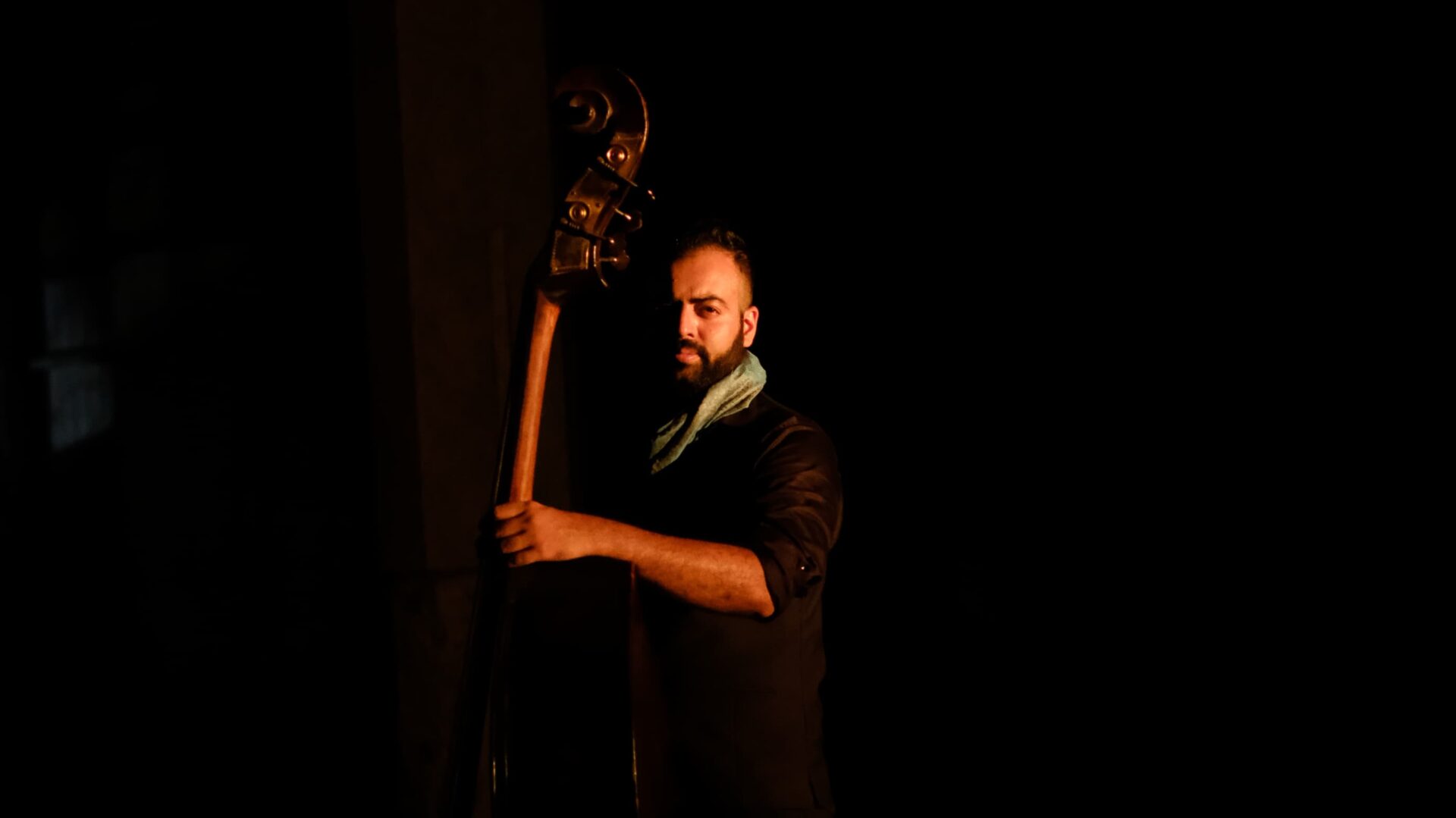
Debjit Mahalanobis has spent his life asking what the bass can do, and then building the answers.
A homeschooled start
Debjit's music began at home. Music and ideas run in the family — his paternal great-uncle was the statistician P.C. Mahalanobis, and his mother's side descends from Pt. Ramshankar Bhattacharya, founder of the Bishnupur dhrupad-dhamar gharana. Long before any stage or conservatory, his family taught him the fundamentals of Indian music on the harmonium. Then rock found him — Led Zeppelin, The Who — and as a preteen he picked up the guitar, before sliding almost immediately over to the electric bass.
The low end had already claimed him.
A new teacher : Falling for the double bass
At seventeen, his first teacher, Abraham Mazumdar, opened the door to Western classical music. He began on the cello — but it was the double bass he fell for, and never really left.
The leap : Leaving the safe road
He did the sensible things first: a science degree, a Master's in Computer Applications, and a steady job teaching physics at a high school. It lasted three years. Then he walked away to give his life to the one thing that kept calling — music.
Three years into a steady job, he left it all for music.
The orchestra years
He joined the Calcutta School of Music and took the principal double bass chair with the Calcutta Chamber Orchestra. Within a year he held the same seat with the Indian National Youth Orchestra and the Bombay Chamber Orchestra. It was here that he trained under the double bassist Dr. Hans Jürgen Nagel, and shared the stage with conductors from around the world — Vijay Upadhyay, Nicholas Pendlebury, and Zubin Mehta among them — before joining the Indo-European Chamber Orchestra in Hyderabad, the South Asian Symphony Orchestra, and the Bangalore City Chamber Orchestra.
The turn : A sound of his own
Then he began to wander off the written page. He collaborated beyond the orchestra — with dancers, theatre-makers, electronic and underground musicians, folk and regional artists. Drum-and-bass experiments, film scores, jingles, indie records. Everywhere he went, he carried the double bass somewhere it wasn't expected: into Indian music.
What can the bass become in Indian music?
Gajveena : The instrument that wasn't there yet
That question eventually needed an instrument of its own. It became the Gajveena — a nearly seven-foot, nine-string acoustic bass-veena that marries the depth and resonance of the double bass with the voice of the rudra veena. In 2026 it was named a finalist at the Guthman Musical Instrument Competition at Georgia Tech. Alongside it, Debjit continues to study Dhrupad under the rudra veena maestro Ustad Bahauddin Dagar, scion of the twenty-generation Dagarvani lineage.
He wants to make the double bass a better-known instrument in India — and to show the world everything it can still become.
Further reading